
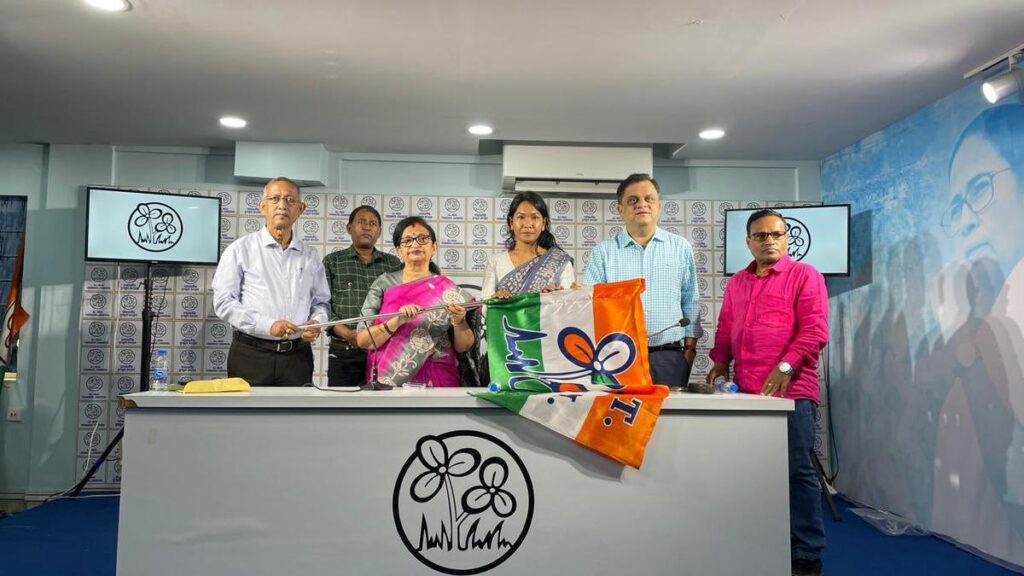
The High Court at Calcutta (Circuit Bench at Jalpaiguri) recently took up a significant matter involving one of India’s most celebrated athletes, Swapna Barman. The case, Swapna Barman vs. Senior Divisional Personnel Officer & Anr. (WPA 468 of 2026), presents a fascinating intersection of service law, disciplinary proceedings, and the fundamental right to participate in the democratic process.
Table of Contents
The Background: An Athlete in Transition
Swapna Barman, an Arjuna Awardee and Asian Games gold medalist, was appointed as a Staff and Welfare Inspector in the Indian Railways in 2020. Her stellar career as a heptathlete is well-documented, but her recent transition toward a potential political career has led to a legal impasse with her employer, the North East Frontier (N.F.) Railway.
The controversy began on February 27, 2026, when Barman attended a press conference conducted by a political party. Expressing a desire to work for the welfare of society, she reportedly accepted membership in the party. This action triggered a disciplinary proceeding under Standard Form No. 5 (used for major penalties) dated March 9, 2026, alleging a violation of Railway Service Rules which generally prohibit employees from political involvement.

The Legal Conflict: Resignation vs. Discipline
Barman subsequently tendered her resignation on March 16, 2026. However, the pendency of disciplinary proceedings often acts as a bar to the acceptance of a resignation, especially when the employer intends to impose a “major penalty” such as dismissal—which carries the additional sting of disqualifying the individual from future government employment.
Key Legal Arguments for the Petitioner:
- Judicial Review: Relying on the Bombay High Court’s precedent in Rutuja Ramesh Latke vs. MCBM, Barman’s counsel argued that the Court has the power of judicial review over discretionary disciplinary matters to prevent arbitrary actions.
- Political Career as a Right: With Assembly Elections approaching, Barman argued that the delay in accepting her resignation is a hurdle to her fundamental right to contest elections.
- Willingness to Forgo Benefits: In a bold move, the Petitioner expressed readiness to face stringent penalties—including the loss of retiral benefits and terminal service—provided her resignation is accepted, allowing her to move forward with her political aspirations.
The Railway’s Stance
The N.F. Railway, represented by the Deputy Solicitor General of India (DSGI), maintained a firm but pragmatic position. They indicated that if the Petitioner is willing to accept her fault and forgo pensionary rights and other service-related benefits, the Department would be prepared to consider her resignation and the issuance of a ‘No Objection Certificate’ (NOC) immediately.
The Court’s Direction: A Time-Bound Resolution
Justice Gaurang Kanth, presiding over the matter, did not issue a final verdict but set a strict timeline to ensure the Petitioner’s rights are not rendered moot by bureaucratic delay.
The Court directed that:
- The Petitioner make a formal proposal to the competent authority by 5:00 PM today.
- The competent authority must communicate its decision within 48 hours (by Friday, March 27, 2026).
Legal Significance
This case highlights the “golden cage” of government service rules. While service rules maintain the neutrality of the executive, they can occasionally clash with an individual’s transition into public life. The court’s intervention here suggests a “balancing of equities”—ensuring the Railway’s disciplinary authority is respected while preventing that authority from being used to permanently block a citizen’s path to the ballot box.
As the matter is scheduled to reappear on Friday, all eyes will be on whether the Railway Authority accepts Barman’s “surrender” of benefits in exchange for her political freedom.
Order was passed as follows:
“The Petitioner has preferred the present writ petition seeking acceptance of her resignation letter dated 16th March, 2026. The Petitioner further seeks conclusion of the disciplinary proceeding initiated against her vide Standard Form No. 5 dated 09.03.2026.
It is the case of the Petitioner that she is a celebrated Indian heptathlete of national and international repute. It is further contended that she won a gold medal at the 2018 Asian Games and secured first place in the heptathlon at the 2017 Championship. The Petitioner has also been honoured with the Arjuna Award. It is further contended that, in the year 2022, she won gold medals in the high jump and heptathlon at the National Games conducted in India.
Mr. Chowdhury, learned Senior Counsel appearing for the Petitioner, submits that on 7th January, 2020, the Petitioner was appointed as Staff and Welfare Inspector (S & WI) (Level-6) in the Personnel Department of the Indian Railways, North East Frontier Railway, Alipurduar. He further submits that on 27th February, 2026, the Petitioner attended a press conference conducted by a political party. At the said press conference, the Petitioner expressed her appreciation of the said party, following which she was offered membership on account of her desire to work for the welfare of society. Since she had attended the press conference, a memorandum of disciplinary proceeding was issued against her in Standard Form No. 5 dated 09.03.2026. Subsequently, the Petitioner tendered her resignation on 16th March, 2026.
Learned Senior Counsel for the Petitioner has drawn the attention of this Court to the Railway Servants (Discipline and Appeal) Rules, 1968 (hereinafter referred to as “the said Rules”), and submits that, in terms of Rule 6 relating to penalties and disciplinary authority, one of the major penalties that may be imposed upon the Petitioner is dismissal from service, which shall ordinarily disqualify her from future employment under the Government or the Railway Administration. He further submits that the Petitioner is willing to face stringent penalties, including curtailment of her future retiral benefits and termination from service.
Learned Senior Counsel has relied upon a judgment of the Bombay High Court in Writ Petition (L) No. 32602 of 2022 (Rutuja Ramesh Latke vs. The Municipal Corporation of Greater Mumbai & Ors.), and submits that even where disciplinary proceedings fall within the domain of the respondent authority, this Court may exercise its power of judicial review. The mere discretion vested in the respondent authority to decide disciplinary proceedings does not preclude this Court from exercising such jurisdiction. He further submits that, since the Petitioner intends to contest the forthcoming Assembly Elections, acceptance of her resignation is crucial to her future prospects. It is imperative that the respondents do not act arbitrarily and consider the same within a time-bound manner, thereby enabling her to contest the elections. He submits that, balancing her fundamental rights, the Petitioner is entitled to contest an election, and that the pendency of disciplinary proceedings on the ground that she participated in a press conference organised by a political party and addressed the gathering should not adversely affect her future advancement or political career. He further submits that the respondents would not be prejudiced if the Petitioner’s resignation is accepted on appropriate terms and conditions.
Mr. Mazumder, learned DSGI, submits that if a proposal is made to the Department wherein the Petitioner accepts her fault, seeks termination, and expresses her willingness to forgo her pensionary rights and other benefits accruing from service, her request for resignation and issuance of a ‘No Objection Certificate’ shall be considered immediately. He further submits that if such a request is made by the Petitioner today by 5:00 PM to the competent authority, the competent authority shall communicate its decision within 48 hours, i.e., by Friday (27.03.2026).
Let the matter appear on Friday (27.03.2026).
Parties to act on server copy of this order.
(Gaurang Kanth, J.)“
Disclaimer: This blog post is for informational purposes only and does not constitute legal advice.