
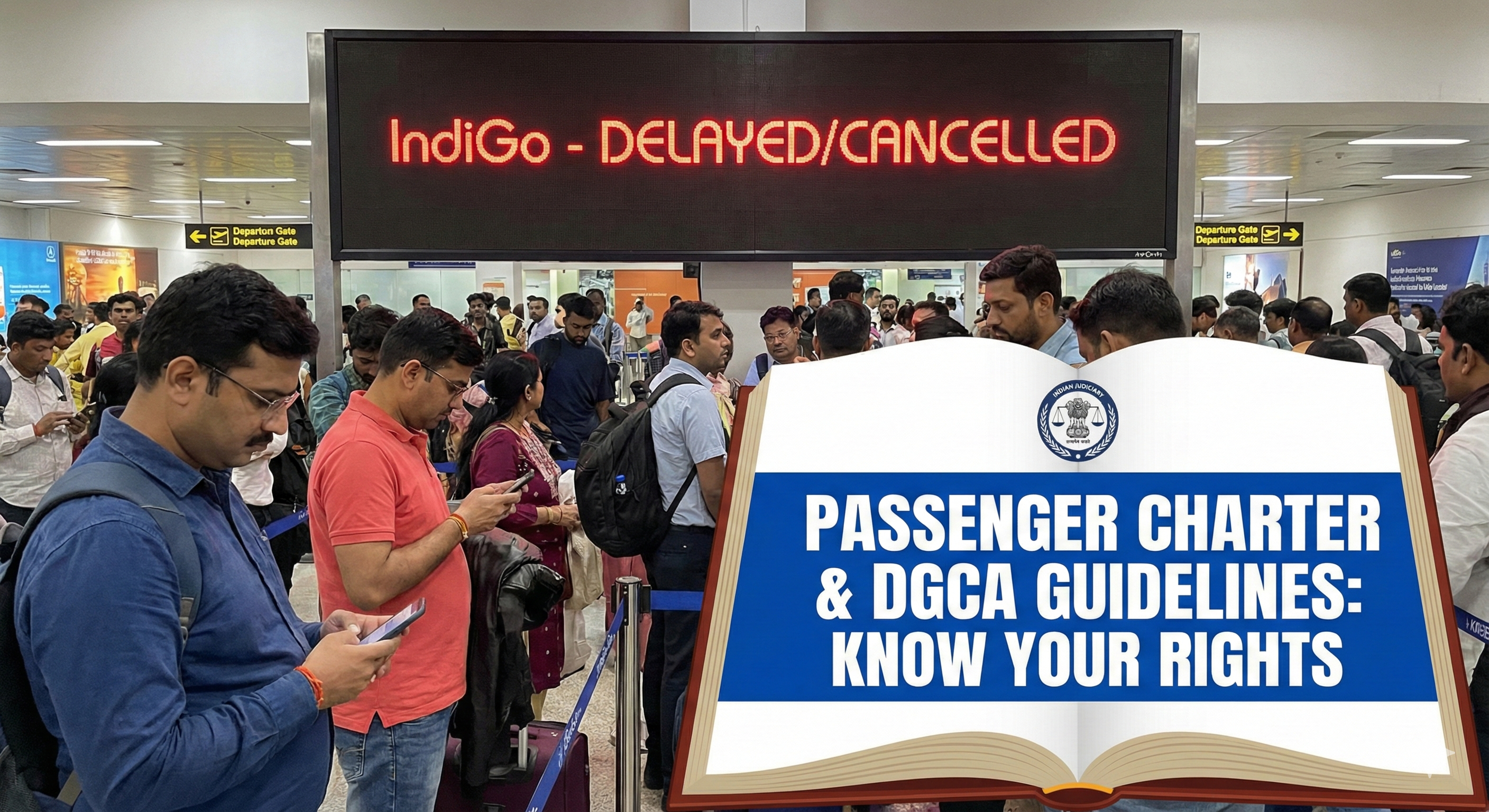
The first week of December 2025 brought Indian aviation to a near standstill. IndiGo—India’s largest carrier—cancelled nearly 5,000 flights within days, leaving thousands stranded at airports: newlyweds missed their receptions, students missed exams, families couldn’t reach medical emergencies. While the airline cited “operational challenges,” the crisis exposed a critical gap: nearly 90% of Indian air travelers don’t know they’re entitled to compensation, refunds, and mandatory facilities when flights are disrupted. Here’s what most passengers miss—an airline ticket is a contract, and when that contract is broken, Indian aviation law provides you with enforceable rights. This article explains what you’re entitled to and how to claim it.
Table of Contents
DGCA CAR Section 3, Series M, Part IV
The Directorate General of Civil Aviation (DGCA) has established specific regulations governing passenger rights. These are not voluntary airline “policies”—they are legally binding government mandates applicable to all airlines operating in India, including foreign carriers.
A. If Your Flight Was Cancelled
When an airline cancels your flight, your rights depend on how much advance notice you received:

Notification Timeline:
Informed 2 weeks or more in advance:
- Airline must offer: Alternate flight OR full refund (your choice)
- No compensation required (adequate time to make alternative arrangements)
Informed between 72 hours and 2 weeks:
- Airline must offer: Alternate flight OR full refund (your choice)
- No compensation required
Informed less than 72 hours but more than 3 hours before departure:
- Airline must offer: Alternate flight OR full refund (your choice)
- No statutory compensation required (but you may claim for deficiency in service)
⚠️ CRITICAL THRESHOLD: Informed LESS THAN 3 HOURS before scheduled departure:
This triggers the full compensation regime. You are entitled to:
- Full refund of your ticket (including all taxes and fees), OR
- Alternate flight at no additional cost, PLUS
- Monetary compensation
Compensation Tiers (Based on Flight Block Time):
The amount depends on your flight’s “block time”—the total scheduled duration from gate departure to gate arrival:
- Block time up to 1 hour: ₹5,000 or (basic fare + fuel charge), whichever is less
- Block time 1–2 hours: ₹7,500 or (basic fare + fuel charge), whichever is less
- Block time over 2 hours: ₹10,000 or (basic fare + fuel charge), whichever is less
Important Clarification: If your ticket cost is less than the prescribed compensation amount, you receive compensation equal to your ticket cost plus a full refund. The compensation is in addition to the refund, not instead of it.
Additional Facilities During Cancellation:
While waiting for an alternate flight, airlines must provide:
- Meals and refreshments (for passengers who have already checked in)
- Communication facilities (two phone calls or emails)
- Hotel accommodation if the alternate flight is the next day (including ground transport to/from hotel)
B. If Your Flight Was Delayed
Delays trigger a progressive “duty of care” based on duration:
Delay of 2 Hours or More:
The airline must provide complimentary meals and refreshments to all passengers who checked in on time. The specific schedule:
- Up to 2 hours: No meal required
- 2-4 hours: Meals/refreshments appropriate to time of day
- Beyond 4 hours: Meals every 4 hours thereafter
Delay of More Than 6 Hours:
When a domestic flight is delayed by over 6 hours from the published scheduled departure time, you are entitled to:
- Alternate flight (within 6 hours if available), OR
- Full refund of your ticket (your choice)
Overnight Delays:
If the delay necessitates an overnight stay, the airline must provide:
- Hotel accommodation (airline selects the hotel)
- Ground transportation between airport and hotel
- Meals during the waiting period
Your Right to Refuse: If you’re dissatisfied with the delay or alternate arrangement, you have the absolute right to refuse to travel and demand a full refund. The airline cannot compel you to accept their alternative.
C. If You Were Denied Boarding (Overbooking)
Airlines sometimes sell more tickets than available seats. If you have a confirmed booking, arrived on time, but were denied boarding due to overbooking:
Step 1: Airlines must first ask for volunteers willing to give up their seats in exchange for benefits. If you volunteer, you can negotiate the terms.
Step 2: If you are denied boarding involuntarily (without your consent):
- If alternate flight departs within 1 hour of your original flight: No compensation, but alternate flight at no cost
- If alternate flight departs more than 1 hour later (or no alternate offered): You are entitled to:
- Compensation (₹5,000/₹7,500/₹10,000 based on flight duration), PLUS
- Full refund OR alternate flight (your choice), PLUS
- Meals, refreshments, and hotel accommodation while waiting
Refund Processing: Know Your Timelines
The DGCA mandates strict deadlines for refund processing. Airlines cannot delay indefinitely:
For Direct Bookings with Airlines:
- Credit card payments: Refund must be processed within 7 calendar days
- Other payment methods (debit card, net banking, cash): Refund within 7 working days
For Bookings Through Travel Agents/OTAs:
- Airline must transfer refund to agent within 7 working days
- Agent must then pay you within 21 calendar days of receiving funds from airline
If Refunds Are Delayed: This constitutes a violation of DGCA CARs and forms grounds for formal complaints via AirSewa and potential legal action for deficiency in service.
The “Force Majeure” Defense: When Can Airlines Refuse Compensation?
Airlines frequently invoke “Force Majeure” or “extraordinary circumstances” to deny compensation claims. Understanding when this defense is valid is crucial.
What Qualifies as Extraordinary Circumstances?
The DGCA CAR defines these as events beyond the airline’s control that could not have been avoided even if all reasonable measures had been taken. Recognized examples include:
✓ Natural disasters (earthquakes, floods, cyclones)
✓ Severe weather rendering flight operations unsafe
✓ Political instability, civil unrest, or war
✓ Air Traffic Control strikes or restrictions
✓ Government orders affecting aircraft operations
✓ Security threats
✓ Airport infrastructure failures (runway closures, power failures)
What Does NOT Qualify as Force Majeure?
❌ Internal operational failures (crew shortages due to poor planning)
❌ Technical issues that could have been detected through proper maintenance
❌ Rostering failures and scheduling mistakes
❌ Aircraft reallocation decisions
❌ Late arrival of inbound crew or aircraft due to the airline’s own network issues
The IndiGo Crisis: A Case Study
The December 2025 IndiGo crisis presents an instructive example. Could the airline validly claim force majeure?
The Facts:
- New FDTL regulations were notified in January 2024
- Implementation occurred in July and November 2025
- Airlines had nearly 11 months to prepare
- Other carriers (Air India, Akasa) adapted successfully to the same regulations
- IndiGo maintained a hiring freeze and pay freeze for pilots during this period
- The DGCA stated IndiGo flagged no compliance issues before the crisis
Legal Analysis:
Indian courts and consumer forums have consistently held that advance notice eliminates the extraordinary circumstances defense. When an airline has adequate time to adapt but fails to hire sufficient crew, adjust schedules proactively, or implement proper workforce planning, such failure cannot be attributed to circumstances beyond control.
Force majeure requires that disruptions “could not have been avoided even if all reasonable measures had been taken.” Here, reasonable measures were available but not taken. Industry experts and the government itself characterized the situation as “poor planning” and “wilful negligence.”
Your Stance: Do not automatically accept “operational reasons” or “new regulations” as valid excuses for denying compensation. Operational mismanagement is not force majeure. If the plane was grounded because the airline couldn’t schedule a pilot despite adequate advance warning, that is an administrative failure, not an act of God.
Passengers affected by the IndiGo December 2025 crisis have strong legal grounds to claim compensation.
Claiming Your Rights: A Strategic Roadmap
Knowing your rights is only the first step. Here’s how to actually enforce them when airlines fail to comply:
Step 1: Build Your Paper Trail (Evidence Collection)
Documentation is the foundation of any successful claim. From the moment disruption occurs:
Immediate Actions:
- Save all booking confirmations, e-tickets, and boarding passes
- Take screenshots of flight status updates and cancellation notifications
- Note the exact time you were informed of cancellation/delay
- Request written confirmation from airline ground staff stating the specific reason for disruption
- Take photos of airport information boards showing flight status
- Photograph your boarding pass with visible time stamps
- Keep receipts for ALL expenses (meals, hotel, transport, phone calls)
- If denied facilities (meals, hotel), document this refusal in writing if possible
Contact Details Verification:
- Ensure your mobile number and email are correctly registered with the airline
- Check your booking confirmation—if contact details are wrong, airlines may argue they attempted notification
Critical Point: The burden of proof regarding notification timing often rests with the airline, but strong documentation on your end prevents disputes.
Step 2: File Complaint with the Airline
Every airline must designate a Nodal Officer and Appellate Authority for passenger grievances (as mandated by DGCA). These details must be displayed on the airline’s website.
Your Complaint Should Include:
- Flight details (date, flight number, PNR, booking reference)
- Clear description of the disruption and when you were informed
- Specific DGCA CAR provisions violated (cite “Section 3, Series M, Part IV”)
- Your claim: refund amount + compensation amount + reimbursement of expenses
- Supporting documents attached
- Request for response within 30 days
Keep copies of all correspondence and note down any reference numbers provided.
Step 3: Escalate to AirSewa Portal
If the airline doesn’t respond within 30 days OR provides an unsatisfactory response (denying valid claims without proper justification):
Visit: www.airsewa.gov.in or download the AirSewa mobile app
File a Complaint With:
- Complete flight details and documentation
- Copy of your airline complaint and their response (or lack thereof)
- All supporting evidence uploaded
AirSewa is monitored directly by the DGCA and Ministry of Civil Aviation. The government tracks airline response rates and can initiate enforcement action for non-compliance. You receive a unique complaint tracking number.
Timeline: Airlines typically respond within 2-4 weeks under AirSewa monitoring. The platform creates regulatory pressure that internal airline complaints often lack.
Step 4: The Legal Notice (When Administrative Remedies Fail)
If your complaint remains unresolved after exhausting airline and AirSewa channels, the next strategic step is sending a Legal Notice.
What Is a Legal Notice?
A legal notice is a formal pre-litigation communication sent through legal counsel. It shifts the conversation from “customer service complaint” to “documented legal demand with consequences for non-compliance.”
Why Send a Legal Notice?
A well-drafted legal notice serves multiple strategic purposes:
- Formal Legal Demand: It clearly states your entitlements under DGCA CARs and demands compliance within a specified timeframe (typically 15-30 days)
- Creates Documented Trail: If you ultimately proceed to consumer court, the notice demonstrates you attempted resolution before litigation
- Corporate Legal Review: Unlike customer service teams, a legal notice reaches the airline’s legal department, which understands the costs of defending indefensible positions
- Settlement Leverage: Many airlines prefer settling valid claims at this stage rather than incurring litigation costs, legal fees, and potential adverse publicity
- Demonstrates Seriousness: It shows you’re not going away and are prepared to enforce your rights through judicial channels
When Is a Legal Notice Appropriate?
Consider sending a legal notice when:
- The airline has ignored your complaints despite proper documentation
- The airline acknowledges liability but unreasonably delays payment
- The compensation offered is significantly less than your legal entitlement without valid justification
- You’ve exhausted AirSewa without resolution
- You want to formalize your position before committing to consumer court proceedings
What Should the Notice Contain?
A properly drafted legal notice should include:
- Precise flight details and timeline of events
- Specific DGCA CAR provisions violated (Section 3, Series M, Part IV)
- Detailed calculation of amounts owed (refund + compensation + documented expenses)
- Timeline for compliance (typically 15-30 days)
- Clear statement of consequences: “Failure to comply will compel us to initiate appropriate legal proceedings before the Consumer Disputes Redressal Commission”
- Demand for written confirmation of payment
How VakilTech Can Assist
Sending a legal notice doesn’t require expensive full legal representation. VakilTech’s Legal Notice Service provides a cost-effective solution for passengers seeking to formalize their claims:
What We Offer:
- Professional Drafting: Legally sound notices citing specific DGCA provisions and case law
- Quick Turnaround: Draft and dispatch within 2-3 business days
- Proper Service: Legally valid dispatch via registered post/speed post with acknowledgment
- Affordable Pricing: A fraction of the cost of full litigation or hiring a lawyer for court representation
- Clear Documentation: Complete paper trail for potential consumer court proceedings
Important Clarification: While we cannot guarantee any specific outcome, our experience shows that airlines often respond more seriously to legal notices than to customer complaints. It’s the most cost-effective tool to escalate your claim and “force a human review” by the airline’s legal team.
Step 5: Consumer Disputes Redressal Commission (Consumer Court)
If the legal notice doesn’t yield results, your final recourse is filing before the appropriate Consumer Commission:
Jurisdiction Based on Claim Value:
- District Consumer Commission: Claims up to ₹50 lakh (previously ₹1 crore)
- State Consumer Commission: Claims between ₹50 lakh and ₹2 crore
- National Consumer Commission: Claims exceeding ₹2 crore
What You Can Claim in Consumer Court:
Unlike DGCA’s statutory compensation limits, consumer courts have awarded:
- Full ticket refunds and related taxes/fees
- Reimbursement of documented expenses (hotels, alternate transport, meals)
- Statutory compensation as per DGCA CARs (₹5,000-₹10,000)
- Additional compensation for mental agony and harassment (ranging from ₹25,000 to over ₹5,00,000 in cases of gross deficiency)
- Litigation costs and legal fees
Critical Point: DGCA compensation is the floor, not the ceiling. Consumer courts regularly award amounts substantially exceeding statutory minimums when airlines demonstrate callous disregard for passenger rights.
The Process:
- Court fees are nominal (typically ₹100-500 for most passenger claims)
- You can appear personally or through an advocate
- Cases are generally decided within 3-6 months (though delays occur)
- Consumer courts are designed to be accessible without extensive legal knowledge
Class Action Option: For mass disruption events like the IndiGo crisis, affected passengers can file class action complaints under Section 35 of the Consumer Protection Act, 2019, allowing collective redressal and reducing individual costs.
Don’t Let Your Rights Fly Away
The IndiGo crisis may have stabilized, but the principle remains: airlines are legally accountable when they fail to deliver contracted services. Whether through operational mismanagement, inadequate planning, or simple non-compliance, passengers are not helpless when their rights are violated.
Your entitlements under DGCA CARs are not favors—they are enforceable legal rights backed by government regulations and consumer protection law. The key to realizing these rights is awareness, documentation, and strategic persistence.
If you’ve been affected and are owed compensation or refunds that the airline refuses to provide, take the first formal step today. A properly drafted legal notice can often resolve disputes without the need for lengthy court proceedings, making it a practical and cost-effective tool for holding airlines accountable.
Frequently Asked Questions (FAQs)
1. The airline says the cancellation is due to “Operational Reasons.” Is this Force Majeure?
No. Force Majeure covers uncontrollable events like natural disasters. The IndiGo crisis stemmed from crew shortages despite 11 months’ notice of FDTL regulations—this is administrative failure, not an Act of God. You have strong grounds to contest and demand compensation.
2. They’re offering me a “Credit Shell” instead of a refund. Can I refuse?
Yes. DGCA explicitly states involuntary credit shells violate aviation law. You’re entitled to a full cash refund to your original payment method. Airlines cannot force you to accept vouchers or future travel credits. Stand firm and cite DGCA guidelines.
3. I booked through a travel agent (MakeMyTrip, Cleartrip, etc.). Who gives me the refund?
The airline must refund the OTA within 7 days; the OTA then pays you within 21 days. If delayed, ask the airline for the Refund Reference Number and the agent for proof. Name both parties in complaints to prevent blame-shifting.
4. Is the ₹5,000–₹10,000 compensation automatic?
No. You must actively claim it by filing a written complaint citing DGCA CAR Section 3, Series M, Part IV. Specify the compensation amount based on your flight’s block time. If the airline rejects without valid proof of Force Majeure, escalate via AirSewa or legal notice.
5. The airline staff said they ran out of food vouchers during the delay. What should I do?
Pay for meals yourself and keep all receipts. Photograph your boarding pass showing the delay. You can claim reimbursement for reasonable expenses as “actual damages” in your complaint or legal notice. Consumer courts routinely order airlines to reimburse documented expenses.
6. Will sending a Legal Notice guarantee I get my money?
No lawyer can guarantee outcomes, but legal notices significantly improve your odds. Airlines often prefer settling valid claims over litigation costs (₹50,000-₹1,00,000+). It’s the most cost-effective escalation tool, demonstrating serious intent and creating a documented record for potential consumer court proceedings..
Disclaimer: The information provided in this article is for general educational purposes ad does not constitute legal advice. Passenger rights and compensation eligibility depend on the specific facts of each case, including factors such as weather conditions, advance notification timing, and the nature of the disruption. Outcomes of legal notices and consumer court proceedings cannot be guaranteed and depend on individual case circumstances, quality of evidence, and judicial discretion. We strongly recommend consulting a qualified legal professional to assess the viability and strategy for your specific claim before taking formal legal action. Past results are not indicative of future outcomes.

Passionate about using the law to make a difference in people’s lives. An Advocate by profession.